
Synopsis:
The global food system is facing severe and rising supply-chain disruptions with costly impacts. This blog highlights the 5 biggest disruptors affecting food production and availability today. It also reveals how Cropin directly addresses four of these challenges with intelligent, data-driven solutions. With proactive risk management, Cropin continues to help agri-food businesses strengthen resilience and secure supply continuity.
Introduction:
Food production and agricultural supply chains face are severely impacted and food supply chain disruption is no longer an anomaly. Whether due to climate change, pests and diseases, geopolitical shocks, or evolving regulations, the volatility is real and the consequences are expensive and far-reaching. Leveraging Artificial intelligence (AI) and machine learning (ML) in agriculture are no longer optional; they’re essential to secure food production and manage risks and ensure supply chain resilience and ultimately deliver surety of supply.
This blog explores the key drivers of disruption, the measurable costs incurred, and how AI-powered tools, specifically those from Cropin, can address four out of the five main disruptors, complete with real-world examples and impact numbers.
Key drivers of food supply chain disruptions
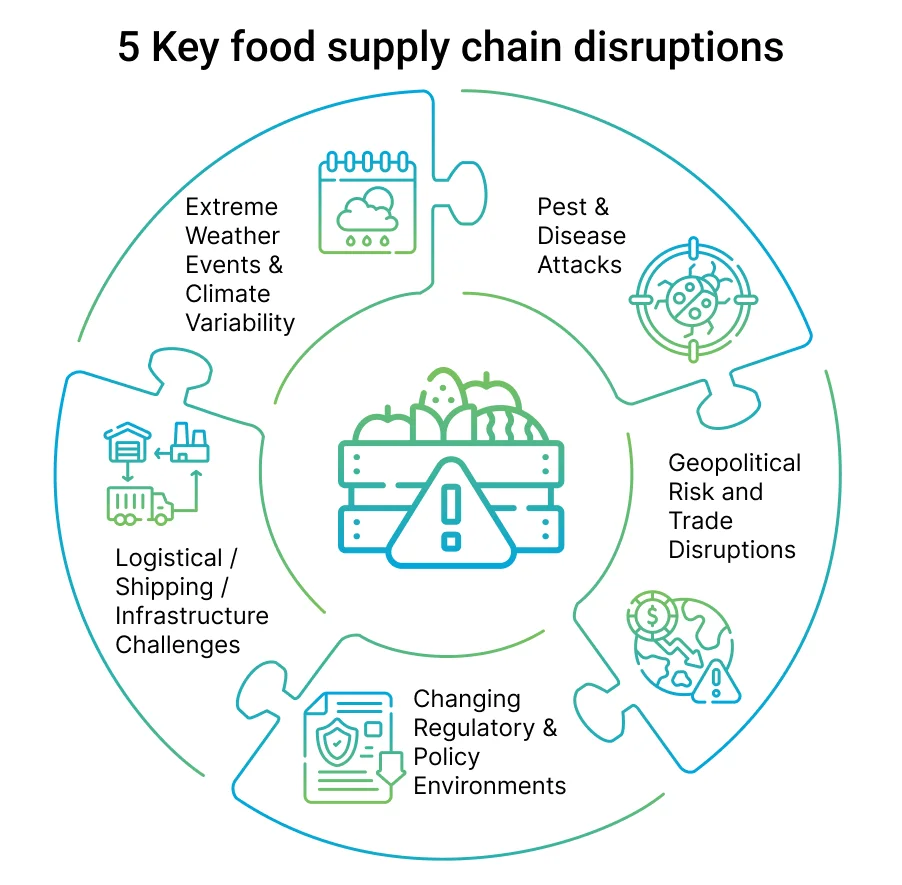
Below are five major categories of disruption affecting food systems globally. Though a host of other challenges exist (labor shortages, input costs, soil degradation, etc.), these five together capture most of the volatility.
1. Extreme weather events & climate variability
Changing rainfall patterns, higher frequency of droughts and floods, heatwaves, unseasonal storms, all are actively reducing predictability in agri-food systems. This volatility disturbs crop calendars; results in sharp yields drop; and harvested quantity & quality suffer.
2. Pest & disease attacks
Outbreaks of pests or pathogens can devastate value chains. Today’s climate change chaos has aided the spread of diseases and pests. For example, in recent years, the cocoa value chain has seen disease pressures that not only cut yield but disrupted supply, raised prices, and harmed downstream players. Globally, up to 40% of crops are lost each year to pests/diseases, costing the global economy hundreds of billions annually.
3. Geopolitical risk and trade disruptions
Wars, trade embargoes, new tariffs, pest/disease spread across borders, export bans, disruptions in major shipping routes can suddenly restrict supply or spike increase cost of certain crops. The Ukraine and Russia conflict, for instance, had far-reaching ripple effects in the global grain and oilseed supplies. It stressed food security across continents.
4. Changing regulatory & policy environments
Governments are increasingly implementing stringent rules around traceability, sustainability (carbon footprint, deforestation, water usage), food safety, pesticide residues, and more. Companies that fail to comply – risk penalties, loss of market access, and irreparable reputational damage.
5. Logistical / Shipping / Infrastructure challenges
Even when production meets demand, getting food from farms to processing plants and finally to consumers is complex. Port congestion, shipping delays, cold chain failures, rising transport costs, labor bottlenecks are just some factors that affect delivery. These issues particularly have detrimental effects on perishables, causing spoilage, waste and delay. The result, unpredictability in the final retail environment.
The costs of these disruptions
When agricultural supply chains are disrupted, the impacts are large and multifaceted:
- Revenue losses: Companies face missed harvests, lower yields, or the inability to fulfill long-term contracts.
- Cost pressure: Businesses must reroute shipments, pay premiums for alternate sourcing, and cover losses from crop failures.
- Food waste / quality loss: Perishable goods spoil in transit; poor quality leads to consumer rejection; and logistics delays degrade freshness and shelf life.
- Forecasting failures: Mismatches in demand and supply lead to either costly overstocking/waste or sudden, damaging shortages.
- Impacts on governments & societies: At a national level these disruptions can in no time lead to food insecurity, inflation in staple prices, and pressure on government budgets. There emerges a pressure on imports, and a risk of civil unrest or health crises.
These costs are not theoretical. Companies lose millions. Governments struggle to ensure domestic food security. Societal welfare is affected. The urgency lies not just in mitigating business risk, it’s about sustaining livelihoods and feeding growing global populations.
How Cropin helps solve 4 of the 5 disruptors
Cropin’s solutions are designed to address four of the five categories of disruption head-on. By moving away from fragmented systems and embracing AI-powered agri-intelligence, companies gain the control they need.
1. Countering extreme weather & climate variation
Climate smart agriculture (CSA) requires accurate, granular intelligence for proactive adoption.
- Cropin’s approach: We enable climate smart agriculture (CSA) practices, regenerative agriculture transition, and continuous farmer advisories through enhanced monitoring and forecasting tools. Cropin platform offers accurate intelligence about weather, soil, and climate trends so decision makers (farmers/retailers/CPGs) can adapt proactively.
- The Intelligence: Cropin Cloud, our real-time ag-intelligence platform, uses grid-based mapping powered by Google Gemini to deliver climatic, soil, irrigation, and growing-condition data at fine spatial scales. This helps seed manufacturers, food processors, governments, and retail businesses to future proof their procurement strategies.
- The Proof: With 30 million acres digitized and nearly one billion acres monitored worldwide, the scalability of the Cropin Cloud platform gives seed manufacturers, food processors, governments, and retailers the strongest possible climate risk coverage, enabling proactive strategic planning.
2. Mitigating pest & disease attacks
Pest and disease outbreaks can destroy up to 40% of global yields, making early intervention critical.
- Cropin’s approach: We implement disease early warning systems (DEWS), indicating the probability of disease occurrence up to 15 days in advance. Our AI-based model integrates crop science; past and forecasted weather attributes like temperature, humidity and precipitation, remote sensing and historical field data to predict disease. To ensure near real-time data our satellite monitoring capabilities monitor crop health across regions.
- The Intelligence: The platform delivers advisories directly to field officers, ensuring proactive action before an outbreak becomes systemic.
- The Proof: Cropin’s collaboration with major retailers, such as Walmart, focuses specifically on monitoring crop health and forecasting seasonal transitions so that fresh produce supply chain risks including those from diseases are detected and mitigated at the earliest possible stage.
3. Navigating geopolitical risk & trade disruptions
Geopolitical instability requires businesses to rapidly shift sourcing strategies to ensure continuity of supply.
- Cropin’s approach: We provide regional intelligence and scenario simulation tools (utilizing Gen AI) that allow companies to quickly assess and shift sourcing or production. The platform enables faster decision-making and the ability to rapidly replicate successful practices in different, less volatile geographies.
- The intelligence: Our sage platform uses a combination of historical, real-time, and predictive data to help businesses understand which growing regions remain viable under severe trade or climate disruption, allowing for the establishment of resilient alternative supplier networks.
- The Proof: Cropin’s customer footprint spans 100+ B2B customers across many geographies, providing the foundational data and expertise necessary to map risk and enable effective, diverse sourcing strategies on a global scale.
4. Ensuring compliance with changing regulatory environments
Meeting evolving environmental, social, and governance (ESG), food safety, and traceability standards demands verifiable, transparent data from farm to fork.
- Cropin’s approach: We offer comprehensive traceability tools, supply chain transparency, monitoring of input usage, and compliance modules, all integrated into digital monitoring, reporting, and verification (dMRV). Organizations can define, structure, and quantify greenhouse gas emissions and soil carbon sequestration.
- The intelligence: Our open ecosystem platform, built upon farm-level intelligence, includes validation models for tillage, cover crop, deforestation analysis, carbon footprint analysis and more. Our platform helps you to seamlessly integrate required data from other sources.
- The Proof: Our solutions directly help large retail and food partners meet complex regulatory and ESG requirements. The platform’s granular pin-code level mapping confirms compliance around origin of produce, soil usage, and irrigation practices, deforestation, instilling consumer and regulator confidence. Cropin’s unbiased dMRV facilitates validation of your compliance with environmental regulations and standards. With our API outputs and customized BI dashboards, you can adhere to all compliance and regulatory norms with ease.
Note:
While Cropin’s superior forecasting and risk mitigation tools indirectly help manage the Logistical / Shipping / Infrastructure Challenges, the platform does not currently manage logistical / shipping infrastructure challenges like port congestion or cold chain breakdowns directly.
How cropin is transforming agriculture with AI: Real-world impact
Cropin’s AI-powered solutions are helping businesses and farmers tackle these challenges head-on. Here’s how Cropin’s AI-powered solutions are driving measurable impact across continents and different industry segments:
Future-proofing fresh produce supply chains with walmart
Challenge:
Global retailers face challenges in ensuring a consistent supply of fresh produce due to unpredictable weather patterns, pest outbreaks, and logistical disruptions.
Cropin's solution:
In partnership with Walmart, we deployed our cutting-edge AI-powered platform to enhance forecasting, crop monitoring, and sustainability efforts across Walmart’s fresh produce supply chain.
Impact:
- Enhanced forecasting: Improved yield forecasting and seasonal transition predictions.
- Sustainability efforts: Monitored crop health to support sustainable sourcing practices.
- Operational efficiency: Streamlined supply chain operations, reducing waste and improving reliability.
Climate smart agriculture with ADPC
Challenge:
Climate change is threatening the crops taking a devastating toll on agriculture, significantly impacting smallholder farmers in countries like Bangladesh and Sri Lanka.
Cropin's solution:
The Asian Disaster Preparedness Center (ADPC) partnered with Cropin on an impact-focused project funded by The World Bank in Bangladesh and Sri Lanka. The project empowered farmers to adopt climate-resilient practices and mitigate risks.
Impact:
- 90% Adoption rate
- 92% Farmer satisfaction rate
- 30% Increase in crop yields
- 23% Reduction in crop loss
- 65,000 SMS-based farming advisories sent
- Empowered 8000+ farmers
Sustainable sourcing with Loacker
Challenge:
Ensuring traceability and sustainability in the hazelnut supply chain, from farm to final product.
Cropin's solution:
Loacker partnered with Cropin to digitize its hazelnut value chain, implementing farm digitization and traceability solutions.
Impact:
- Digitized operations: Digitized over 16 million acres of farmland.
- Return on investment: Achieved a threefold increase in ROI.
- Quality control: Enhanced traceability and quality assurance across the supply chain.
Early pest and disease warning with Space4Good
Challenge:
Mitigating crop loss due to pests and diseases, which can lead to significant yield reductions.
Cropin's solution:
Space4Good collaboration with Cropin, developed ‘CropLens’, an early warning system for pests and diseases in rice paddies.
Impact:
- Early detection: Provided real-time alerts for pest and disease outbreaks.
- Resource optimization: Reduced fungicide expense by 15%. Reduced use of pesticides minimized environmental impact.
- Farmer support: Empowered farmers with timely information to protect their crops.
- Productivity: 20% increased productivity
Conclusion
Across all the different crops and continents, the core truth is this: agriculture is no longer just about planting and harvesting it’s about having the intelligence to anticipate, adapt, and thrive in a volatile world. Cropin’s AI-powered solutions are driving this essential shift from reactive farming to predictive strategy.
Having digitized over 30 million acres globally and monitoring nearly 1 billion acres, our scalable platform offers farmers, agribusinesses, and supply chain leaders the intelligence they need to make informed, timely decisions. Think about it: whether it’s safeguarding Walmart’s fresh produce or securing Loacker’s traceable hazelnut supply, we’re consistently turning complexity into actionable insights for their teams.
The bottom line is that in today’s unpredictable environment, businesses can’t risk relying on fragmented data. By leveraging AI and machine learning and generative intelligence organizations are doing more than just surviving disruption. They’re actively building supply chains that are demonstrably smarter, stronger, and truly future-ready. Every field digitized, every risk prevented, and every yield optimized is a huge step toward making agriculture more predictable, profitable, and sustainable for everyone involved.
Author Bio

Prateek Srivastva
Prateek Srivastva is a Chief Business Officer at Cropin, a global Agtech leader, bringing over two decades of experience spanning technology, consulting, entrepreneurship, and investment. A seasoned serial entrepreneur, he has successfully established and exited three ventures, including a precision agriculture startup focused on perennial crops across three continents. At Cropin, Prateek is responsible for expanding the company’s presence in the critical EMEA region, managing revenue, investments, and academic partnerships. His extensive expertise in the field has earned him global recognition, with features in esteemed media platforms including Fortune, Forbes, and The Economist.